
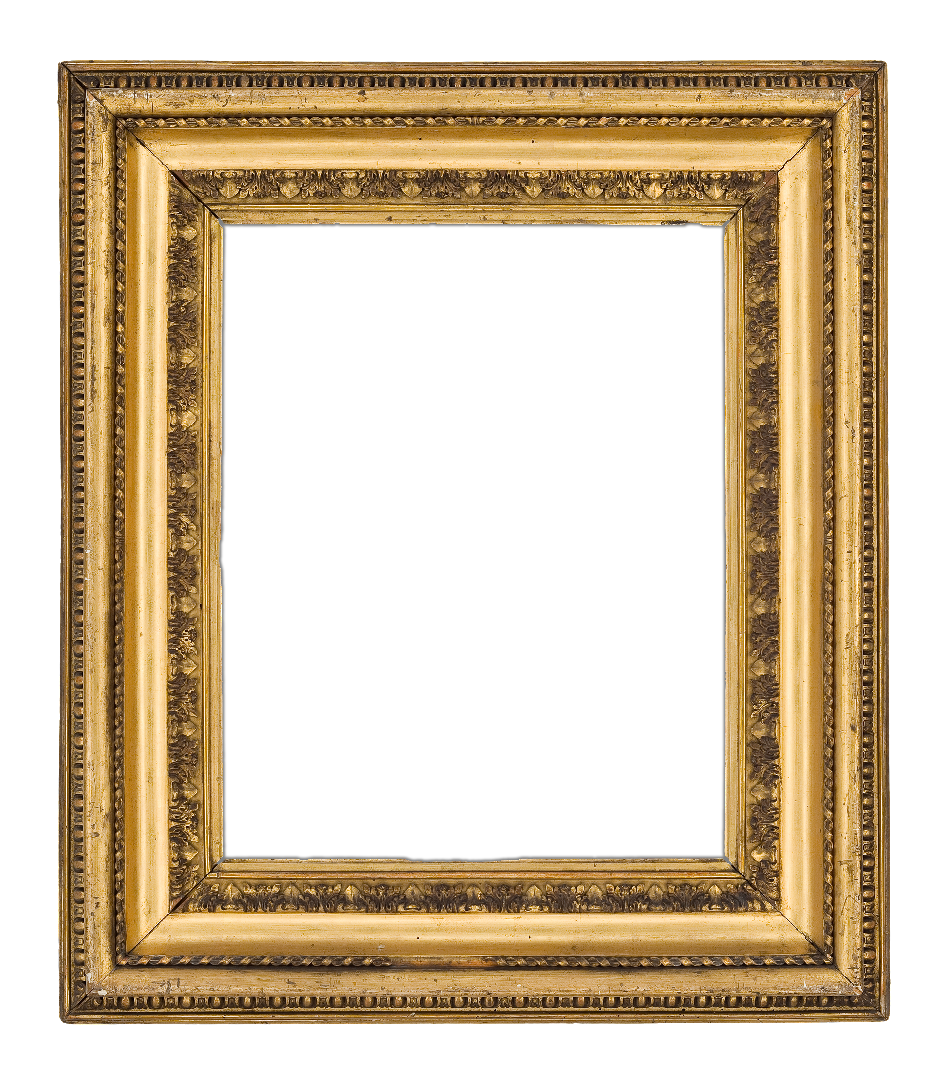
SIZE
Frame Width: 6.5
Sight Height: 24.5
Sight Width: 19.375
DETAILS
Century: 18th Century
Country: Italian
Maker: Salvatore Rosa
ABOUT
Italy was the center of frame making during the Renaissance and Italian frames came to be known for their fine craftsmanship and artistic beauty. The first frames were made for use in a religious context and tabernacle or aedicular frames were created for altarpieces. Molding frames were introduced for secular purposes in the 15th century and marked the beginning of framing as we know it today. The design of the cassetta, or “little box” frame, comprised of a flat panel or frieze with applied raised inner and outer moldings, would continue to be used throughout frame history.
Salvatore Rosa — Salvatore Rosa frames feature continuous molding believed to have been designed by the artist Salvatore Rosa in the late 17th century. These frames typically incorporate two or more rows of continuously carved decorative ornamentation on a cove or concave profile. A similar style frame, the Carlo Maratta frame, was very popular in England.
Cove – Cove frames are a frame molding with a concave profile. Cove frames, also called scotia frames, were commonly used in 19th century American frame designs.
LOWY VIRTUAL FRAMING
Curious to see how your art could look hanging on a wall in a Lowy frame? Using Lowy's Virtual Framing Tool, you can see what your painting could look like in different frames and even how it could look hanging on your wall.
Lowy's Virtual Framing Tool guides you through the simple process. All you'll need to get started is a JPG photo of the unframed artwork, the artwork's dimensions and a photo of your wall.
ARTWORK PHOTO
ARTWORK DIMENSIONS
WALL PHOTO
REQUEST QUOTE
Is there a piece in your collection that you know would look so much better in a new frame? Do you have a large collection of art that needs all new frames but don’t know where to start? Are you searching for a creative solution to display a family heirloom but need some help? Lowy has you covered.
TRUSTED BY